Destination England -
NCO's Training School - Bydgoszcz
|
Go Contents
2. NCO's Training School - Bydgoszcz
As foretold, a week later I received a letter from the school to which
I had applied, requesting me to report for a medical check and entry
exams. That is exactly what I did.
I never liked medicals, but I decided to attend. I managed to get
through most of the difficult tests, but at the end of 'tortures' I had
to go before the Chief Medical Officer. After examining my
reports, he took a long look at me and said "I will pass you, on the
'condition' that you go and see the School Commandant and ask him
whether he will accept you with your height". I was only 5 feet 2
inches tall in shoes.
So I went to look for this Commandant and found him standing with a few
other officers around him. There were too many of them for my
liking, so I lost my courage and, after walking in three large circles
around them, I went to do my exams instead. I passed these with
'flying colours', as I found out later on, fourth place out of 1000!
Eventually the time arrived for the final results. However, the
examining board realised that they didn't have my medical papers and so
they sent me back to see the chief doctor. It was late in the
afternoon and the final results were to be announced shortly. In
order to speed things up, they decided to give me an escort and told me
to follow the Sergeant Major, all 6 feet 2 inches of him! The problem
was that he was on a bicycle whereas I was on foot, and the medical
centre was on the other side of the aerodrome, half a mile away.
By the time we got there I was a bit out of breath.
When the chief medical officer looked at me and noticed I was rather
'overheated', he asked me why. I told him about my 'quick
journey' across the airfield. He laughed and asked if I had
seen the School Commandant. I said "Yes", and fortunately he
didn't ask whether I had actually spoken to him! Anyway I passed my
medicals and, in August 1935, I became a pupil at this school in
Bydgoszcz, which took three long, and sometimes painful, years to
complete.
The purpose of this school was to teach us everything that a good
airman and specialist mechanic (or radio mechanic) needed to
know. This included training new airmen and maintaining aircrafts
in future squadrons, to which we were posted after graduation.
Those who were selected to be pilots had to train as mechanics first,
and were later posted to squadrons to learn to fly. I myself,
having previous knowledge of electricity and radio, was allowed to
continue my training in that direction. During my first year at
school, and with the permission of the commanding officer, I organised
a so called 'Technical Circle'. This circle, which we attended in
our spare time, included lectures and practical hobbies conducted in
the school workshops and laboratories. I became it's chairman,
and out of it's 600 or so members, 95 percent belonged to the three
squadrons - 1st, 2nd and 3rd year.
During these practical hobby sessions, I made a little electrical
gadget which ran on a 4.5 Volt battery made from a midget telephone
transformer (induction coil) and a buzzer. I connected the
gadget's two wired ends to the metal frames of two separate beds and
asked my friends to hold onto the other side of the beds. When I
switched the gadget on, it had the dramatic effect of pulling them
towards the bed without being able to disengage themselves until I
switched it off.
I was often lucky to get out alive after such experiments.
However, one time my luck nearly ran out. It was a different kind
of experiment based on a similar principle. I hung bare aerial
wire between my bedroom window and a wire netting fence about 30 feet
away. I asked one of my friends (if I had any left by this time)
to try and pull the wire so it would be more secure. He
obligingly did this, but unfortunately, he got hold of the aerial with
one
hand, before an insulator was attached to it, while his other hand was
still clenched to the wire fencing. At this point in time, the
second wire of my gadget was connected to the central heating, and I
switched my apparatus on. The outcome was terrifying! The poor
chap couldn't tear himself away from the fence and started
screaming.
Unfortunately for me, the Sergeant Major saw the whole episode from his
office window. As a result my gadget had to be confiscated.
However, everybody was afraid to touch it, so in the end, with 'full
military escort', I had to place it myself into a seldom used desk in
his office which was then locked. After graduation I had the
gadget returned to me with the same kind of ceremony with which it was
confiscated.
However this was not the end of my misfortune and I had to report to
the Commanding Officer of the Squadron. He ordered me to spend
three hours of my free time standing outside, to attention and in full
equipment. I had to remain motionless, and if during this time I
were to try to get rid of fly or wasp trying to land on my nose, I
would be obliged to start that hour again!
In the second year of school, we had a lesson about navigation, which
introduced us to the so called 'triangle of speed' where you have to
give correction to the direction of flight to account for any side
wind. This inspired me to make an instrument which would help the
navigator or pilot to solve this problem. In those days, aircraft
were slower and navigational help not as advanced as today. A
year later, after consultations between the School Commandant and
Air Force Headquarters in Warsaw, I was awarded a prize for this
invention, and I was mentioned in dispatches in front of the whole
school.
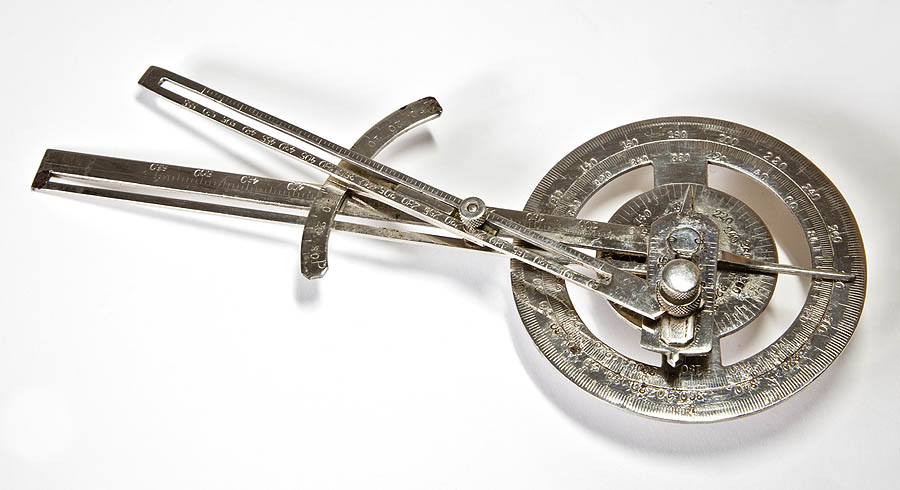
This is the picture of the actual
Navigation Device that Jozef created which has survived the war
During the third year of my education, I was given a special room to
myself, where I could make drawings and build prototypes of future
improvements. I had at my disposal the use of any machinery available
at the school or aerodrome workshops. The same year we (myself,
the committee and members of the Technical Circle) organised an
exhibition of our 'goods', which were seen by the Chief of the Polish
Air Force and of course our parents, and the remaining members of the
circle.
Several months later, in June 1938, we had our final exams followed by
the graduation ceremony during which we received our certificates,
school graduate badges, promotion to leading aircraft man, one month's
holiday and postings to different air force units situated all over
Poland.
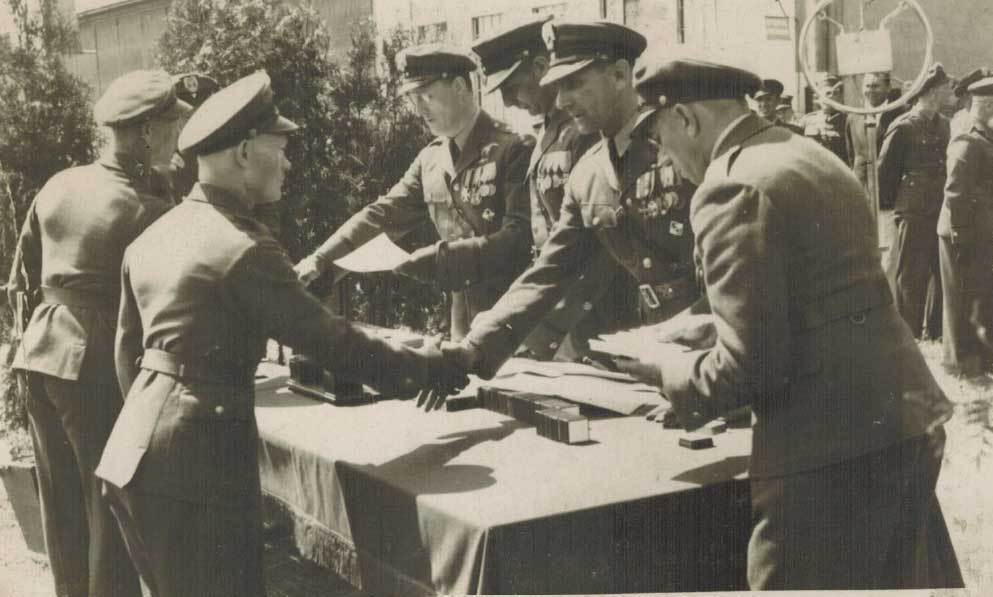
Jozef graduating and receiving his
certificate, graduation badge and promotion to leading aircraft man.
Top Of Page Contents
© Nick Bailey & Krys Bailey (nee Stendera) & Jozef Stendera
2013-2020